
Dad to dad—if you’re heading into court, walk in with a co-parenting plan. Not a rant. Not a pile of screenshots. A clean, organized plan that shows the judge you’ve thought about your child’s day-to-day life and you’re ready to share the load like a grown man. Judges notice that. It reads as stability, preparedness, and respect for the process.
At FatherCustodyCoach.com, we build court-ready co-parenting plans for fathers—clear, tabbed, and easy to follow—so you can present yourself as the steady parent who has a plan, not a problem.
What a Co-Parenting Plan Actually Is
It’s a simple document that answers one question: How will we raise this child across two homes—without chaos?
It covers the calendar, exchanges, decision-making, communication, and how you’ll handle disagreements. Think of it as the playbook that keeps your kid’s life predictable.

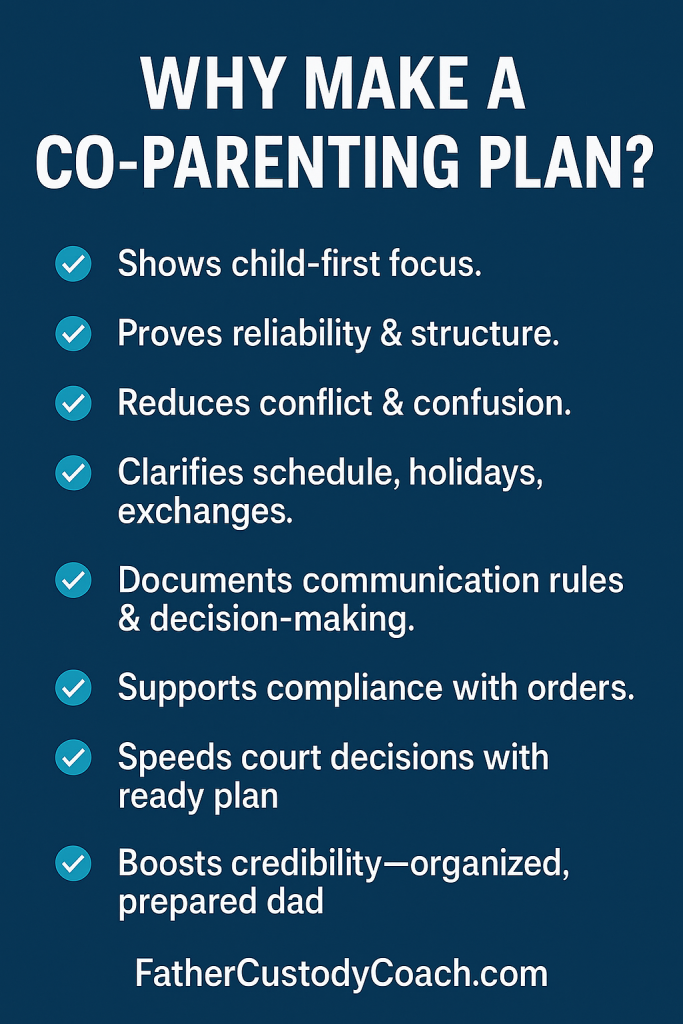
Why Bringing a Plan Helps You in Court
- Shows you’re focused on the child, not the fight. Judges want solutions, not drama.
- Signals reliability. A detailed plan says you’ll follow orders and keep structure.
- Removes guesswork. The court doesn’t have to invent a schedule—you’ve built one.
- Positions you for shared or primary time. Prepared fathers look like leaders, not visitors.
What to Include (Keep It Practical)
Use plain language. Bullet points. No fluff.
- Custody & Parenting Time
- Regular schedule (school year): days, pick-up/drop-off times, and location.
- Weekend/overnight plan.
- Summer schedule and camp/childcare coverage.
- Holidays & Special Days
- Alternate odd/even years (e.g., Thanksgiving, winter break, child’s birthday, Father’s Day).
- Exact start/end times (not “around noon”).
- Exchanges
- Default exchange location (e.g., school, police substation, library).
- Late policy (e.g., 15-minute grace; text if delayed).
- Transportation responsibility.
- Communication
- Co-parenting app or email for logistics (no side chats).
- Weekly check-in window for school/health updates.
- Video/phone time schedule when the child is with the other parent.
- Decision-Making (Legal Custody)
- Joint for education/medical/religion/extracurriculars unless emergency.
- Tie-breaker method: pediatrician/school counselor input, or mediation.
- School & Health
- Both parents listed as contacts.
- Each parent may access grades, portals, and medical records.
- Notice within 24 hours for appointments/illness.
- Expenses
- Uninsured medical, school fees, activities: split percentage (e.g., 50/50).
- Reimbursement timeline and proof (receipt within 30 days via app).
- House Rules Across Homes
- Homework, bedtime range, tech limits, and discipline basics—kept consistent.
- No negative talk about the other parent to the child.
- Travel & Relocation
- Notice period, itinerary sharing, and passport handling.
- Distance limits without new order.
- Conflict Resolution
- Step 1: 48-hour cooling period.
- Step 2: Co-parenting app proposal/response.
- Step 3: Mediation before court unless emergency.
How to Present It in Court (So It Lands Well)
- Keep it clean: 6–10 pages, section headers, page numbers.
- Tab it: Schedule, Holidays, Exchanges, Decisions, Expenses—easy to flip.
- Neutral tone: “Proposes,” “requests,” “parenting schedule,” not “she refuses.”
- One-page summary: A simple calendar grid judges can scan in seconds.
- Bring copies: One for you, the court, and the other parent.
What Judges Frown Upon
- Gatekeeping or weaponizing the child. Don’t block time or bad-mouth.
- Sloppy communication. Swearing, sarcasm, long rants—assume every message is Exhibit A.
- Chaos. Late exchanges, missed school, no childcare plan, unstable housing.
- New partner drama. Keep adult relationships separate from parenting time during the case.
Quick “Start Now” Checklist
- Draft a weekly schedule that actually fits your job hours.
- List holiday rotation for the next two years.
- Pick a co-parenting app (OurFamilyWizard, AppClose, TalkingParents).
- Write a childcare backup plan with real names and numbers.
- Gather school/doctor portal access info for both parents.
- Add a calm communication rule (two sentences, facts only).
Why Having a Plan Helps You Win Credibility
Anyone can complain. Fathers who show solutions are the ones who look like leaders. A judge can build orders straight from your plan, because you’ve already handled the details: where, when, who, how. That’s what “best interests” looks like in real life—structure and consistency.
We’ll Build It With You
At FatherCustodyCoach.com, we create court-ready co-parenting plans tailored to your schedule and your child’s needs. You get:
- A clean, organized PDF with tabs and a one-page summary.
- A calendar you can hand the judge without a speech.
- Coaching on how to present the plan—calm, brief, and focused on your child.
Free consultation: FatherCustodyCoach.com — let’s build the plan and show the court you’re serious about shared custody.
Educational information only — not legal advice. Laws vary by state. For legal advice, consult a licensed attorney.